
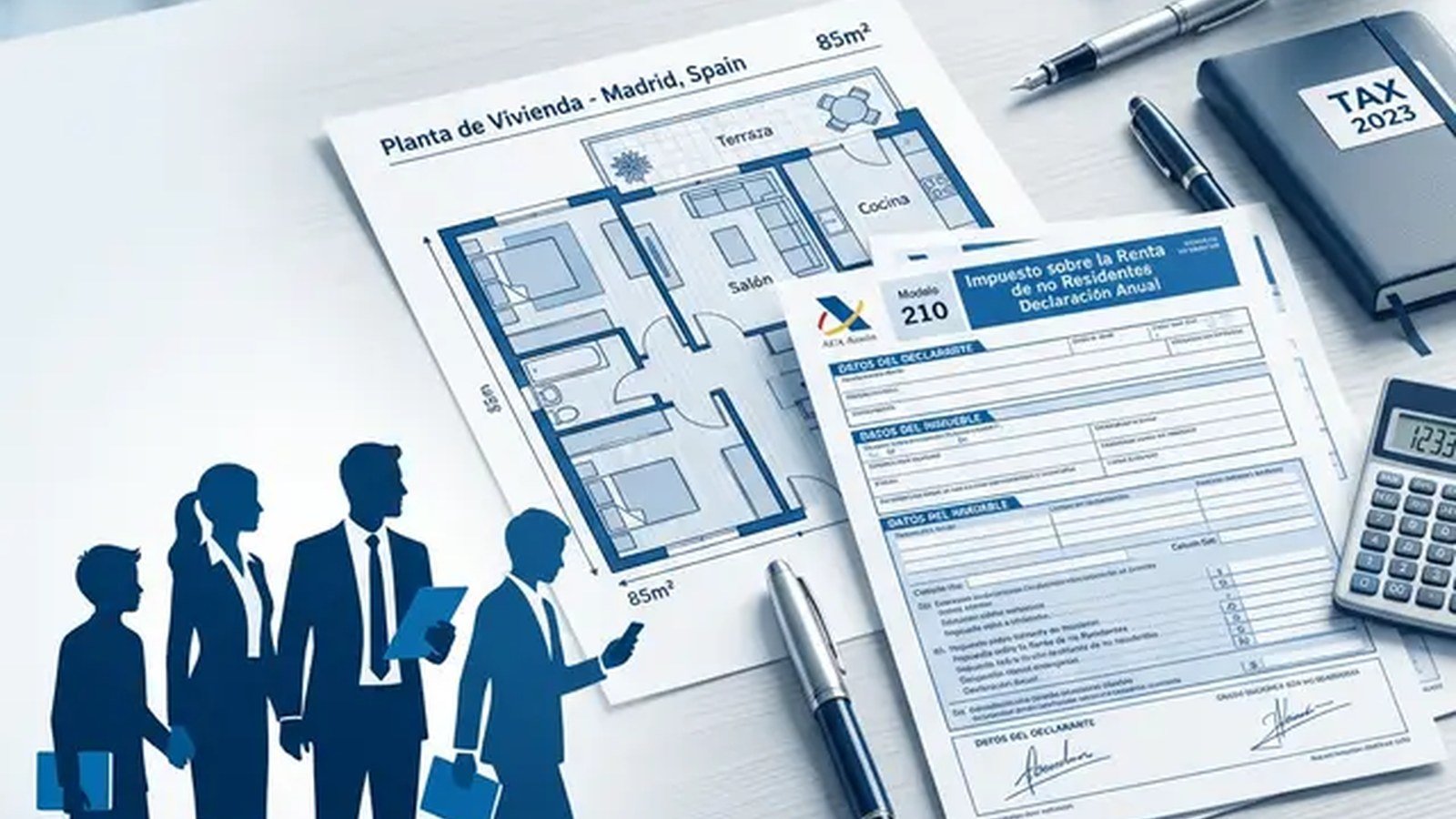
When a property in Spain belongs to multiple owners and one or more of them are tax non-residents, Form 210 (Modelo 210) often becomes more complex than it appears.
In practice, many errors do not stem from the tax itself, but from incorrect income allocation, mixing tax periods, or attempting to file "in bulk" what must be declared individually by each title holder.
In this guide, we cover with a practical approach:
- what to review when there is co-ownership,
- which errors are most frequent,
- how to organize the information,
- and how to avoid future review or regularization issues due to allocation or periodization errors.
Why Does Form 210 Get Complex with Multiple Owners?
Because the tax analysis is not performed solely per property, but also per individual title holder and their specific ownership percentage. As we explain in our section on Form 210 for non-residents, the Spanish Tax Agency expects individual returns.
👉 A single property can generate errors if it is managed as one economic file, without correctly separating the share of each owner.
Core Rule: Each Holder Declares Their Share
Generally, when there are multiple owners:
- Each non-resident holder must file their own Form 210.
- Based on their actual ownership percentage.
- Applying the income and expenses (where applicable) that correspond solely to them.
Frequent Error
Treating the property as if there were only one taxpayer and then "dividing by eye" at the end. This lack of control often leads to missing deadlines for some owners.
Data that Must Be Separated from the Start
To avoid errors, we recommend working with a control sheet per property and per owner. At a minimum, for each owner, track:
- full name and tax ID (NIE)
- actual ownership percentage
- specific tax periods affected
- attributable income and manageable expenses (refer to our list of IRNR deductible expenses)
- filing status by period (Pending / Under Review / Filed)
Common Pitfalls in Co-owned Properties
- Incorrect Income Allocation: Very common when rent enters a single bank account or there is only one rental manager.
- Mixing Tax Periods: Filing only the most recent historical periods while leaving dangerous gaps in the past.
- Disregarding Actual Percentages: Frequent in inheritances or purchases with uneven shares.
- Misallocated Expenses and Depreciation: These must be calculated and justified with traceability for each owner.
- Lack of Organized Documentation: This increases the risk of errors and problems in future reviews or regularization.
Scenarios Requiring Extra Vigilance
Family co-ownership (siblings, spouses with different property regimes) or changes in ownership over time require special attention to ensure you are not declaring for periods or shares that no longer apply.
If you have sold or are planning to sell soon, we suggest reviewing our due diligence property report to ensure the historical tax record is consistent with the transfer.
How to Correctly Organize Your Filing (Practical Method)
- Separate by Property: Identify periods, income types, and total amounts.
- Separate by Holder: Create individual files with the exact ownership percentage.
- Review Documentation: Do not work with global estimates. Check our Form 210 rental guide for the specific records needed.
- Monitor Filing Status: Maintain a simple matrix of (Pending / Under Review / Filed).
Need help with this file?
Send us a short initial enquiry. We will tell you what needs to be reviewed before you engage us.
Request a case reviewFrequently Asked Questions (FAQ)
Is a single Form 210 presented if there are several owners?
No. Each non-resident holder must file their own separate Form 210 based on their ownership percentage.
What if the rent is collected by only one person?
This does not exempt the other owners from their tax obligations. The income must be assigned to each owner according to their title for individual declaration.
Can I use the same allocation for all periods?
Only if the ownership has not changed. If there have been subsequent purchases, inheritances, or donations, the percentages must be adjusted accordingly for each period.
What happens if previous Form 210 returns were filed incorrectly?
In many cases, the situation can be reviewed and a structured regularization can be planned, especially where there are allocation, periodization, or documentation errors.
Legal Disclaimer: Information content of a general nature. The specific application of IRNR/Form 210 requires reviewing the case documentation and the regulations in force at the time of filing.